Interpreters who work in community settings face ethically complex situations every day. Unfortunately, the profession has not been consistent in how it guides and supports interpreters in making the right decision. Most ethical codes in the profession frame ethical ideals as, “interpreters always…” and “interpreters never…”. Yet, how often is the phrase, “it depends on the situation…” uttered by interpreters? To add to the confusion, interpreters hear from trainers and colleagues that interpreters are just, “conduits” or should be “invisible”. Or, interpreters hear the exact opposite: interpreters are “advocates” or they are “members of the team”.
Neither a list of rules nor a series of metaphors can effectively advance ethical thought and action in a practice profession. What is needed instead is a set of professional values and the skills needed to effectively apply those values in a particular context. A values-based framework effectively accounts for the complex work of interpreters do — an does so in a manner that parallels other practice professions.
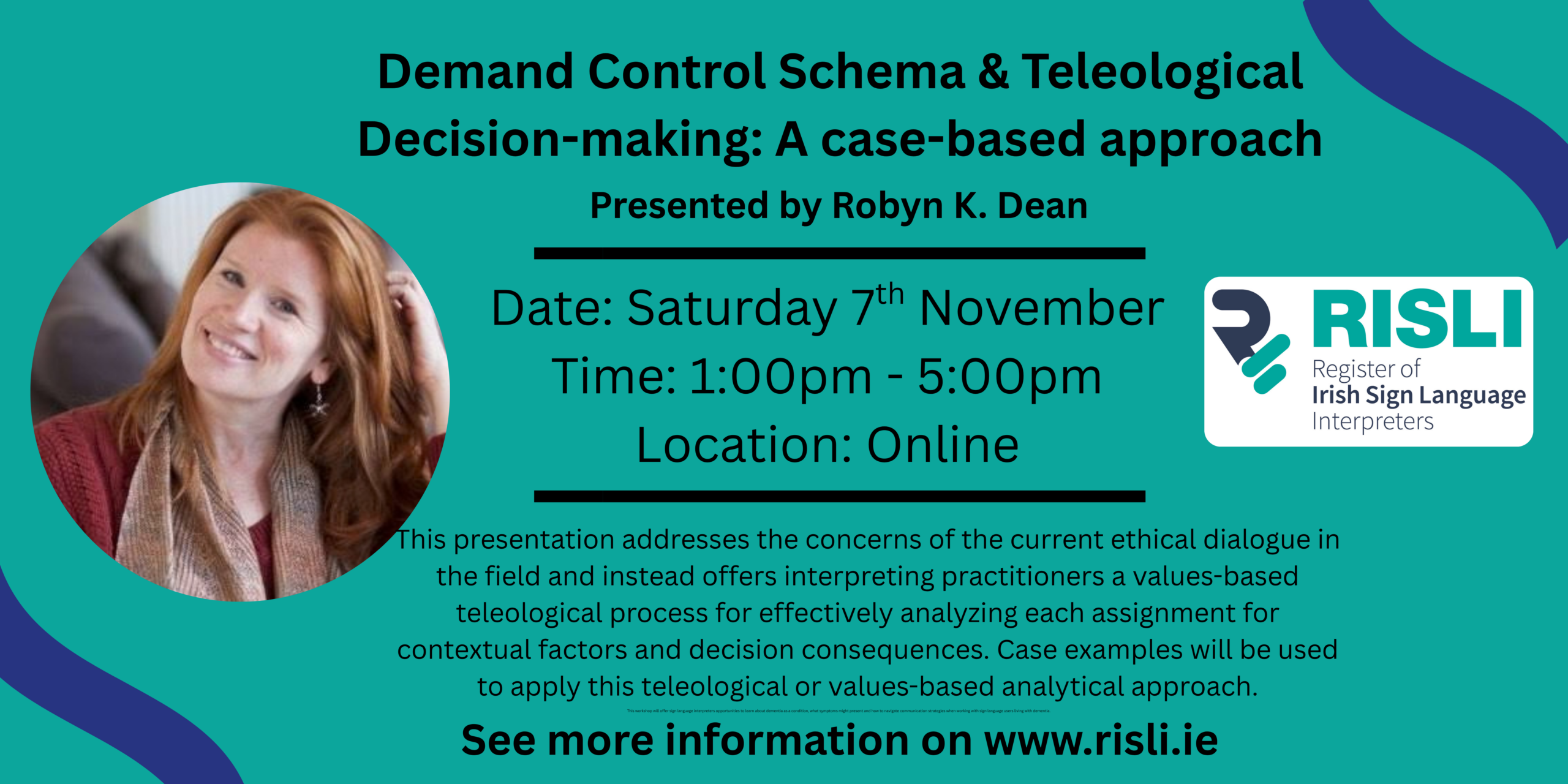
This presentation addresses the concerns of the current ethical dialogue in the field and instead offers interpreting practitioners a values-based teleological process for effectively analyzing each assignment for contextual factors and decision consequences. Case examples will be used to apply this teleological or values-based analytical approach.
Educational objectives:
At the conclusion of the training, participants will be able to:
- Identify the primary concerns for the popular frameworks used in interpreting
- Define a practice profession and the implications of this shift in interpreting
- Explain DC-S as a work analysis tool and a decision-making model
- Outline the values to be considered in decision-making in various community settings
- Explain the professional development tool of supervision and reflective practice
Robyn K. Dean, CI/CT, PhD has been an interpreter for over 35 years, with particular service experience in medical and mental health settings. She conducts workshops internationally on the topics of ethics, reflective practice, work effectiveness, with particular emphases on healthcare interpreting and professional development. Robyn’s demand control schema has been the topic of numerous presentations, publications, grant projects, and most recently a textbook which is being used in interpreter education programs across the globe. Robyn is currently on the teaching faculty as an assistant professor at the National Technical Institute for the Deaf at the Rochester Institute of Technology in the department of ASL and Interpreter Education.